











SQL Server Monitoring Tools: Real-Time Performance Diagnostics
SQL Server Performance Monitoring That Goes Beyond Basic Alerting
SQL Server environments are growing more distributed and complex — spanning on-premises instances, Azure SQL Database, Amazon RDS, VMware, and Hyper-V — while DBA teams and budgets stay flat. Native tools like SQL Server Management Studio and Extended Events provide foundational visibility, but they don’t scale across large estates, can’t predict problems before they happen, and require constant manual effort.
IDERA SQL Diagnostic Manager closes that gap. It delivers real-time diagnostics, predictive alerting, and prescriptive analytics across your entire SQL Server estate from a single, agentless console — with per-instance pricing and no ingest fees.

What Makes SQL Diagnostic Manager Different
Predictive alerts
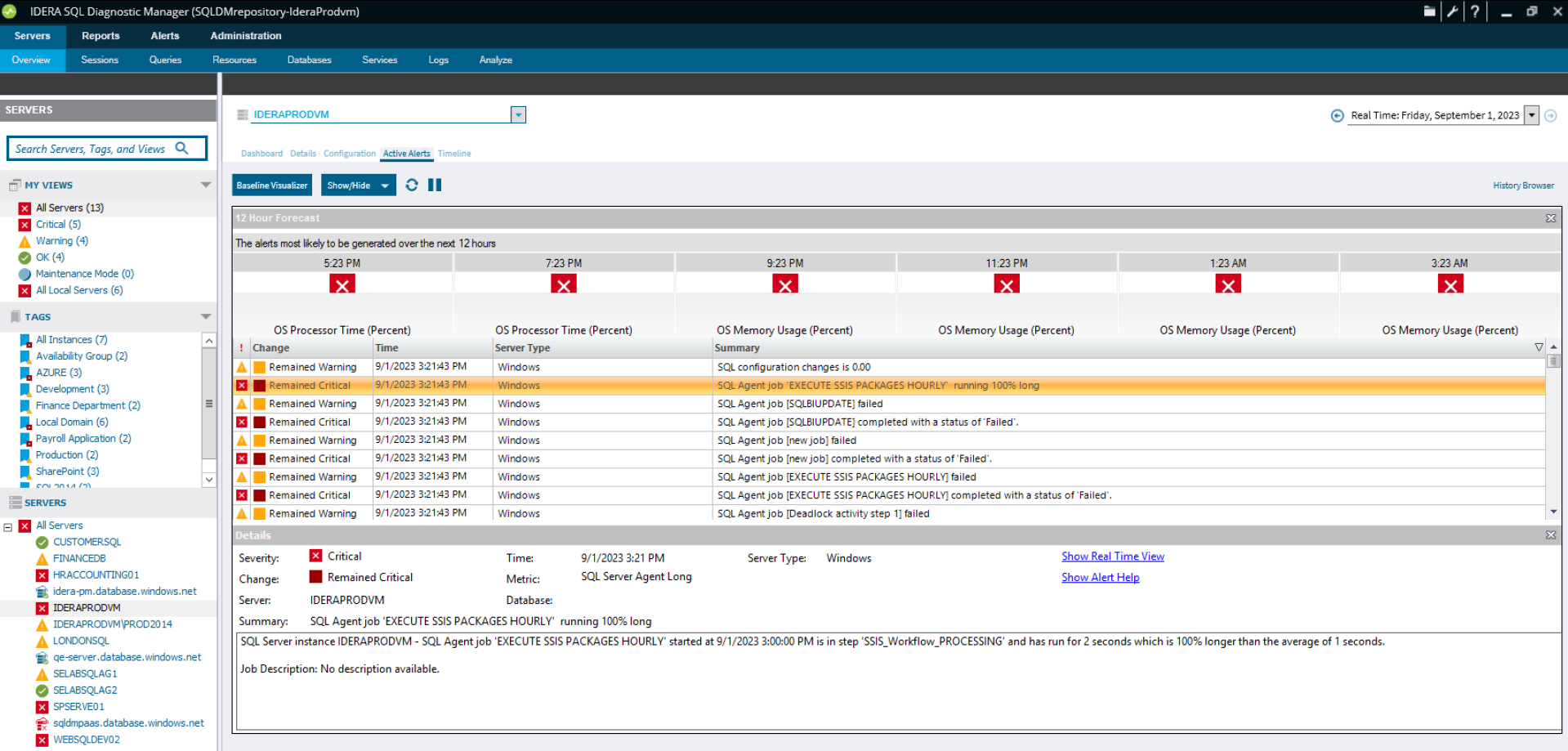
The only SQL Server monitoring tool that analyzes performance trends to surface potential problems before thresholds are crossed, giving DBAs time to act instead of react.
Full-stack visibility
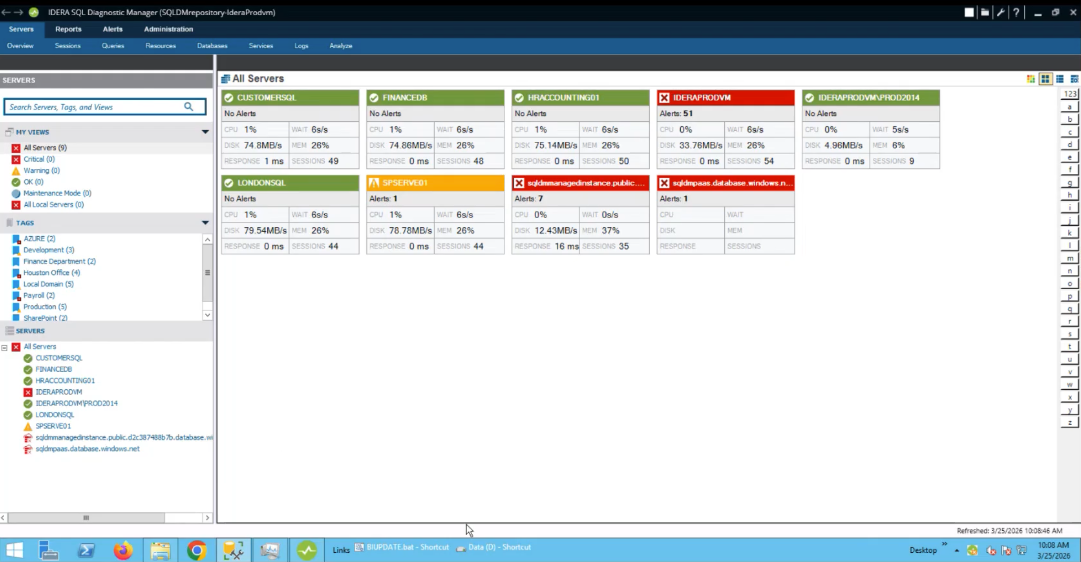
Monitor SQL Server alongside the operating system, storage, VMware, and Hyper-V in one view. Mirroring, replication, Always On Availability Groups, and cluster monitoring are built in at no extra cost.
TempDB diagnostics
Purpose-built TempDB monitoring identifies contention, space pressure, and configuration issues that general-purpose tools miss entirely.
SCOM integration
The only monitoring solution with a native Microsoft System Center Operations Manager (SCOM) plug-in, so SQL alerts surface inside your existing enterprise monitoring stack.
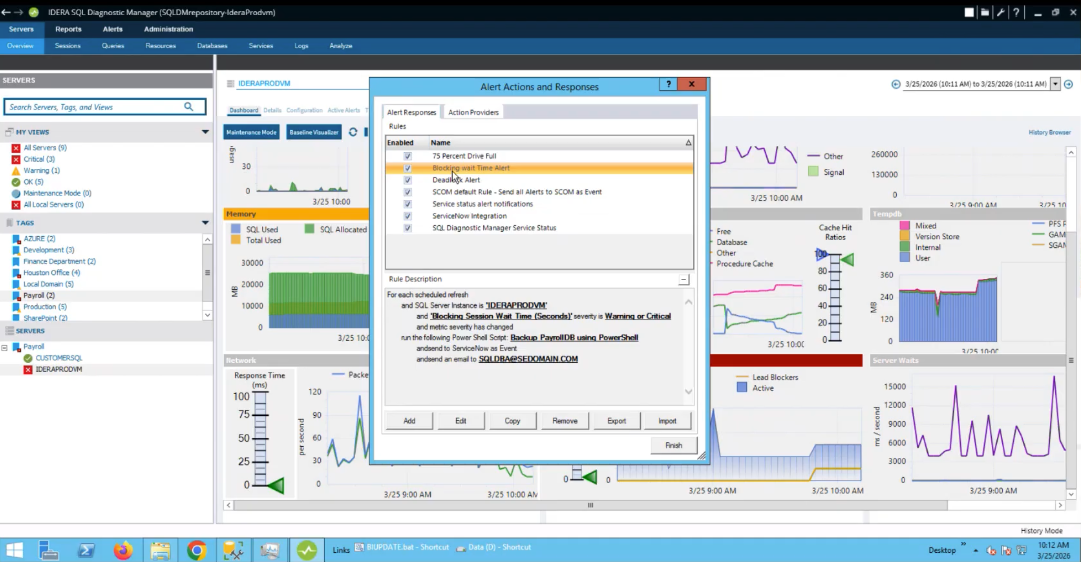
PowerShell automation
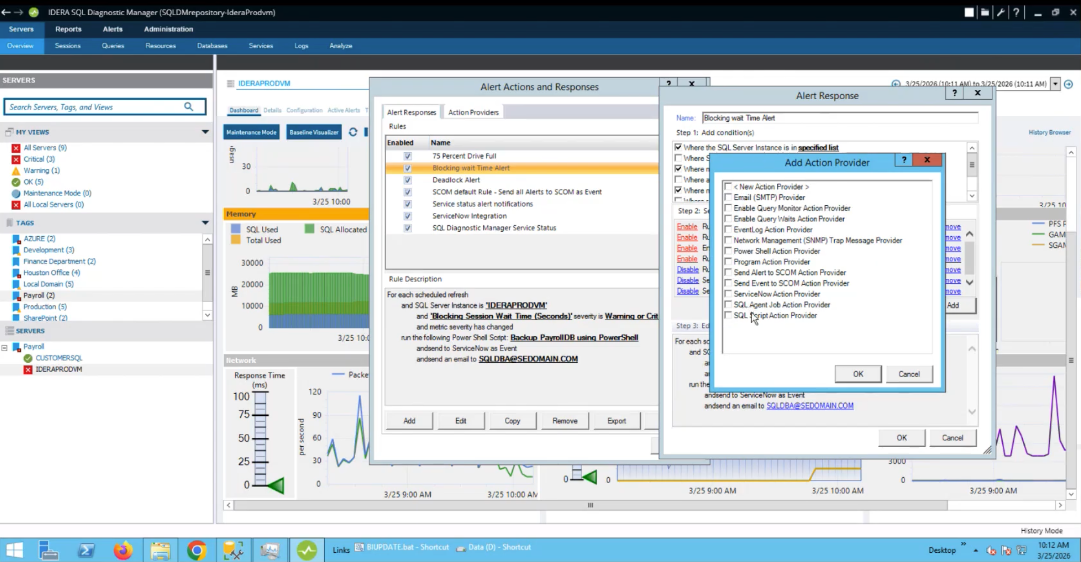
A built-in scripting snap-in lets teams automate alert responses, reporting, and remediation workflows without leaving the platform.
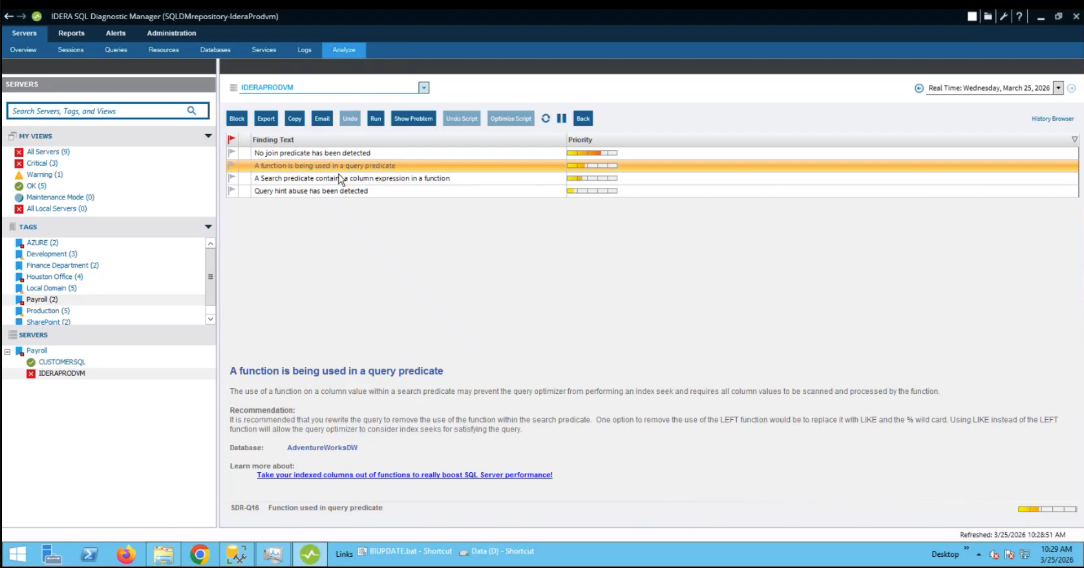
Query-level observability
Capture and analyze slow-running queries with execution plan details, wait stats correlation, and index tuning recommendations to resolve bottlenecks faster.
SQL Diagnostic Manager is part of IDERA’s portfolio of 18 SQL Server tools — including SQL Compliance Manager, SQL Safe Backup, and SQL Secure — giving teams a single vendor for monitoring, security, compliance, and backup across their entire estate.
Monitor SQL Server Performance On-Prem or in the Cloud
SQL Diagnostic Manager delivers proactive SQL Server software monitoring with deep diagnostics to help DBAs quickly identify bottlenecks, troubleshoot issues, and resolve performance problems before they impact users. With real-time insights and historical analysis, teams can establish an accurate SQL Server performance baseline and detect anomalies with confidence.
See Every Layer. Solve the Problem Faster.
SQL Diagnostic Manager delivers complete SQL Server performance monitoring — across on-prem, hybrid, and cloud — so DBAs can find the true cause of slowdowns in seconds
- Query-level observability — plan history, Query Store integration, execution comparison
- Deep root-cause insight — waits, blocking chains, deadlocks, TempDB pressure, I/O latency, and fragmentation
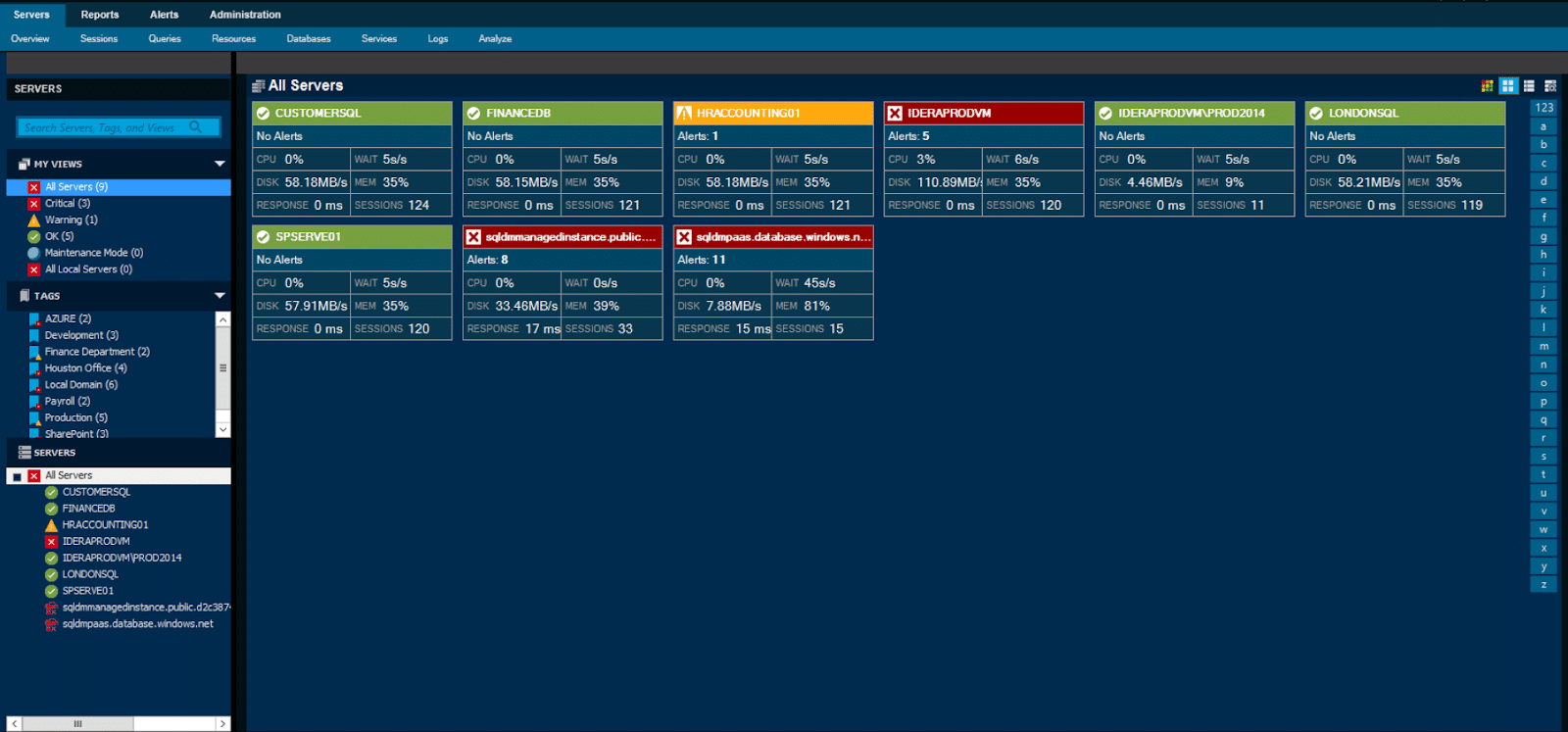
- Cross-tier visibility — from SQL to OS, virtualization, storage, and cloud resources
- Agentless architecture — minimal overhead with full data collection
Let AI Find What Manual Tuning Misses.
SQL Diagnostic Manager now brings AI directly into the diagnostic workflow, helping DBAs move from data to decision faster than ever.
- AI-powered database performance optimization — surface tuning opportunities automatically, without digging through raw metrics
- AI vs. original query comparison — instantly see how a modified query performs against its original, backed by AI-driven analysis
Smarter Insights. Actionable Recommendations.
SQL Diagnostic Manager transforms raw performance data into prescriptive analytics and intelligent recommendations, helping DBAs tune SQL Server efficiently and consistently.
- Prescriptive tuning guidance for CPU, memory, I/O, TempDB, and query performance
- Fragmentation analysis with automatic recommendations
- Cost observability — cloud tagging plus optimization insights to control spend
- Replication monitoring and health scoring
Monitor, Analyze, and Retain Everything — On Your Terms.
SQL Diagnostic Manager offers data ownership, long-term retention, and comprehensive reporting for complete operational clarity and compliance-ready visibility.
- Customer-owned repository for multi-year SQL forensic analysis
- No ingest fees — predictable, per-instance pricing
- Comprehensive reporting suite out-of-the-box, plus fully customizable reports
- Web and thick client options for flexible enterprise workflows
- Scales across large SQL Server estates without performance impact
Features Built for DBAs
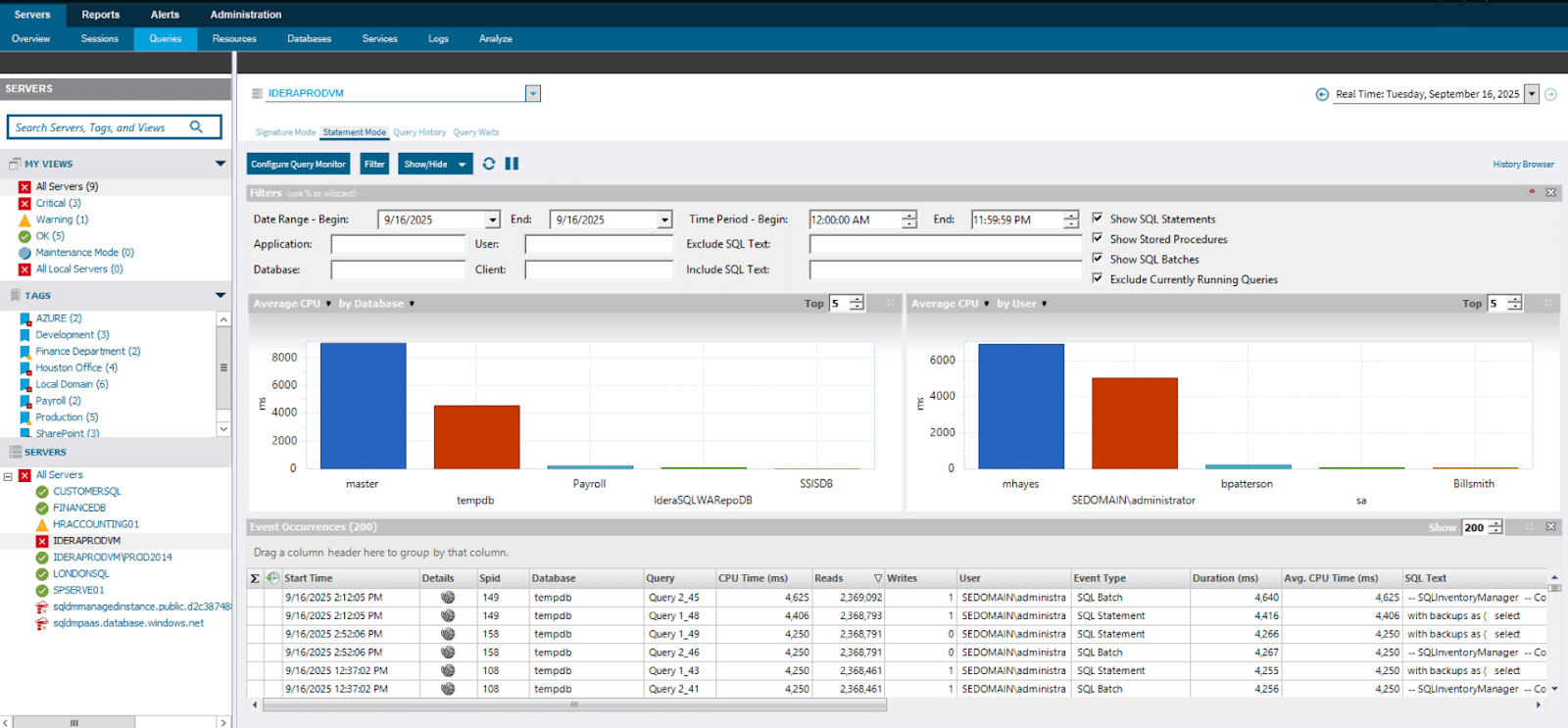
Slow SQL Query Log
Identify and analyze slow-running SQL Server queries with detailed query capture, filtering, and visualizations to quickly pinpoint performance bottlenecks.
SQL Server Alerts
Stay ahead of performance issues with customizable and predictive SQL Server alerts that notify DBAs before problems impact users.
View Expert Advice
Access built-in expert recommendations to resolve common SQL Server performance issues and apply proven tuning guidance across your environment.
SQL GUI
Monitor SQL Server performance and alerts from a single, intuitive interface that gives DBAs fast visibility and control across all databases.
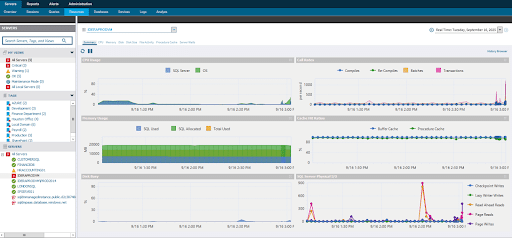
Performance Analysis Dashboard
Get a real-time, at-a-glance view of SQL Server health, trends, and resource usage to quickly understand what’s impacting performance.
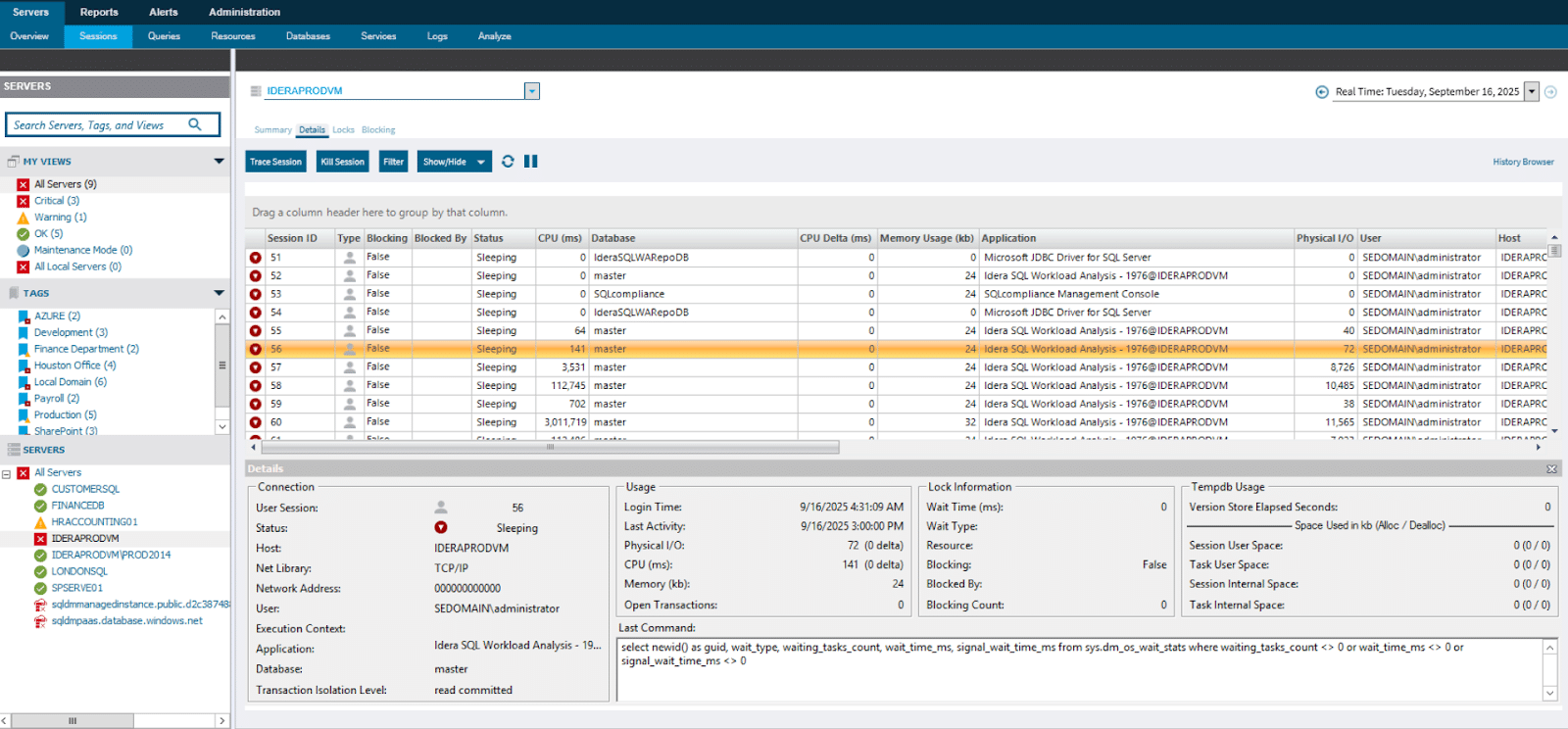
Blocking and Deadlock Detection
Detect, analyze, and resolve SQL Server blocking chains and deadlocks to prevent query slowdowns and application disruptions.
TempDB Monitoring
Monitor TempDB usage, contention, and configuration issues to identify performance risks before they escalate.
Index Analysis
Analyze missing, fragmented, and unused indexes with actionable recommendations to improve SQL Server query performance.
Wait Stats Analysis
Understand where SQL Server is spending time by analyzing wait statistics to uncover root causes of performance degradation.
Compare IDERA SQL Server Monitoring Solutions
SQL Diagnostic Manager, paired with SQL Workload Analysis and SQL Query Tuner, delivers the most complete SQL Server performance monitoring and optimization platform available. This integrated solution allows DBAs to compare performance across environments, workloads, and time periods, combining real-time monitoring, deep diagnostics, and advanced tuning in a single platform. The result is faster issue detection, clearer root-cause analysis, and confident performance optimization at scale.
SQL Diagnostic Manager |
SQL Workload Analysis |
SQL Query Tuner |
|
|---|---|---|---|
| Physical and Virtual Server Monitoring |  |
|
|
| Cloud Monitoring | |
 |
|
| Mirroring, Replication, Clusters, Availability Group Monitoring | |
|
|
| TempDB Monitoring | |
|
|
| Pinpoint Locks, Blocks, and Deadlocks with Drill-down | |
|
|
| Custom Counters | |
|
|
| Custom Reports | |
|
|
| Capacity Planning | |
|
|
| Historical Trends | Performance | Query Plans | |
| Performance Baselines | |
|
|
| Alerting with Predictions and Recommendations | |
|
|
| Adaptive Alert Thresholds | |
|
|
| Automated Alert Response Actions | |
|
|
| Ranked Expert Tuning Advice with Executable Scripts | |
|
|
| PowerShell Scripting | |
|
|
| SCOM Integration | |
|
|
| Customizable and Scalable Desktop Console | |
|
|
| Customizable Web Console | |
|
|
| Mobile Console | |
|
|
| Customizable Dashboard with Drill-down Analysis | Performance | Transactions | |
| Query Monitoring | Basic | Detailed | Detailed |
| Query Wait Time Analysis | Basic | Detailed | Detailed |
| Explain Plans | |
|
|
| Query Tuning and Recommendations | |
|
|
| Query Plan Tuning and Recommendations | |
|
|
| Lock and Latch Resolutions | |
|
|
| Storage Contention Resolution | |
|
|
| Continuous and High-granularity Query Sampling | |
|
|
| Visual Query Tuning | |
|
|
| Batch Query Tuning | |
|
|
| Query Rewrite | |
|
|
| Explain Plan Cost | |
|
|
| Index Analysis | |
|
|
| Continuous Query Profiling with Drill-down | |
|
|
| Query Load Testing Simulation | |
|
|
| Automation Via Command-line Interface | |
|
|
Extended Performance Monitoring and Tuning Capabilities
Take SQL Server performance analysis further with advanced add-on capabilities that go beyond baseline monitoring. These extensions deepen visibility into workload patterns and accelerate query tuning so DBAs can optimize performance with precision and confidence.
SQL Workload Analysis
Dive deeper into SQL Server activity to understand workload behavior and performance trends.
- Wait state breakdown: Analyze detailed wait statistics to uncover bottlenecks and resource contention.
- Continuous workload sampling: See where your SQL Server is spending time with high-granularity performance data.
- Historical analysis and insights: Track query plan trends over time to detect recurring performance patterns.
- Actionable recommendations: Use automatic tuning suggestions to improve query performance and reduce latency.
SQL Query Tuner
Optimize SQL query performance faster with targeted tools that simplify tuning and testing.
- Visual query tuning: Graphically profile and adjust poorly performing SQL queries for faster results.
- Wait-time analysis: Understand how specific queries impact resource waits and overall workload performance.
- Execution plan optimization: Explore and refine execution plans to reduce costs and improve execution efficiency.
- Load testing simulation: Validate query performance under realistic load scenarios before deploying to production.
Download a free, fully functional, 14-day trial of SQL Diagnostic Manager now!


Frequently Asked Questions
What is SQL Server performance monitoring?
SQL Server performance monitoring is the ongoing process of tracking key metrics — CPU, memory, I/O, TempDB usage, wait statistics, blocking, and query execution — to understand how well a SQL Server database is running and to catch problems before they affect users. It typically combines real-time visibility with historical data, so DBAs can compare current behavior against a known-good baseline and quickly spot anomalies like slow queries, resource contention, or fragmentation. Effective monitoring covers every layer of the environment: the database engine itself, the underlying OS, storage, virtualization, and — for hybrid or cloud deployments — resources in Azure, AWS, or GCP. Beyond simply flagging that something is wrong, modern tools like SQL Diagnostic Manager go further with root-cause analysis and prescriptive tuning guidance, helping DBAs move from "something is slow" to "here's exactly what to fix." Done well, performance monitoring reduces downtime, improves query response times, and keeps SQL Server environments reliable as they scale.
Why is SQL Server performance monitoring important?
SQL Server performance monitoring matters because database problems rarely stay contained — a slow query or resource bottleneck quickly becomes a slow application, a frustrated end user, or a missed SLA. Without continuous monitoring, DBAs are stuck reacting to help desk tickets instead of catching issues early, often losing hours tracing a symptom back to its root cause. Proactive monitoring changes that: real-time visibility and predictive alerting surface warning signs — like TempDB pressure, blocking chains, or I/O latency — before they escalate into outages. It also gives DBAs the historical context and baselines needed to tell the difference between normal fluctuation and a genuine problem, avoiding wasted effort chasing false alarms. At scale, this matters even more, since a single database team may be responsible for hundreds of instances across on-premises, virtual, and cloud environments. Consistent monitoring keeps performance, uptime, and user experience predictable, while giving DBAs the evidence they need to plan capacity and justify infrastructure decisions.
How do I choose the best SQL performance monitoring tool?
Start by matching the tool to how your SQL Server environment actually runs — on-premises, virtualized, hybrid, or across multiple clouds — since not every tool monitors all of these consistently from a single dashboard. Look for real-time visibility paired with predictive alerting, so you're warned before issues impact users, not just notified after the fact. Query-level observability matters too: the tool should show execution plans, wait stats, blocking chains, and TempDB pressure, not just surface-level CPU or memory graphs. Favor agentless deployment to minimize overhead, and check whether the tool supports historical baselining, so you can tell normal variation from a real problem. Pricing model matters at scale — predictable per-instance pricing avoids surprise costs as your estate grows, unlike ingest-based pricing that penalizes verbose environments. Finally, consider data ownership and retention: a customer-owned repository supports long-term forensic analysis and compliance reporting that cloud-only SaaS tools often can't match.
How does SQL Server monitoring help with query optimization?
Query optimization starts with knowing which queries are actually slow — and monitoring gives DBAs that visibility through query-level observability, execution plan history, and wait stats analysis. Instead of guessing, DBAs can see exactly where a query is spending time: waiting on locks, blocked by another session, stalled on I/O, or burning CPU on a poor execution plan. Monitoring tools also surface index problems — missing, fragmented, or unused indexes — with actionable recommendations to fix them, rather than requiring manual analysis of query plans. More advanced platforms like SQL Diagnostic Manager go further with AI-powered optimization: analyzing real execution patterns across competing queries to recommend workload-aware index designs, and letting DBAs directly compare a modified query's performance against its original. Because these recommendations are grounded in continuous, historical performance data rather than a single snapshot, DBAs can tune with confidence, prioritize the fixes with the biggest impact, and validate that a change actually improved performance before committing to it.
Can I monitor multiple SQL Server instances at once?
Yes — in fact, most enterprise environments require it. Modern SQL Server monitoring tools are built for centralized, multi-instance visibility, letting DBAs track dozens or even hundreds of SQL Server instances from a single dashboard rather than logging into each one individually. This includes instances running on-premises, in virtualized environments like VMware or Hyper-V, and across cloud platforms such as Azure SQL Database, Azure SQL Managed Instance, AWS RDS, and GCP. Unified, normalized dashboards make it possible to compare performance and health across environments consistently, spotting which instances need attention without switching tools or contexts. This kind of centralized monitoring also supports capacity planning and scalability: as a SQL Server estate grows, predictable per-instance pricing and agentless deployment keep overhead manageable rather than compounding with every added server. For DBA teams managing large, distributed estates, single-pane-of-glass visibility isn't a nice-to-have — it's what makes proactive performance management realistic at scale.
What are the benefits of predictive alerts?
Predictive alerts analyze recent performance trends to flag potential problems before they actually happen, rather than simply reporting on issues after users are already affected. This shifts DBAs from reactive firefighting to proactive maintenance — instead of scrambling to diagnose an outage in progress, they can address rising TempDB pressure, growing blocking chains, or degrading I/O latency while there's still time to act. Predictive alerting also reduces alert fatigue: by understanding what's trending abnormally versus normal fluctuation, DBAs get warnings that matter instead of a flood of static threshold breaches. Adaptive alert thresholds take this further, adjusting sensitivity based on each server's own historical baseline rather than a one-size-fits-all number, which cuts down on false positives across mixed workloads. Combined with automated alert response actions, predictive alerting can also trigger corrective steps automatically for known issues. The net result is fewer surprises, faster resolution when something does need attention, and more DBA time spent on strategic tuning instead of putting out fires.
Do SQL Server monitoring tools support cloud databases?
Yes — modern SQL Server monitoring tools are built to cover cloud and hybrid environments, not just on-premises servers. Support typically extends to Azure SQL Database, Azure SQL Managed Instance, Amazon RDS for SQL Server, and Google Cloud-hosted instances, giving DBAs the same depth of visibility in the cloud that they'd expect on-prem: query-level observability, wait stats, blocking and deadlock detection, and root-cause diagnostics. The best tools go further with unified, normalized dashboards that let DBAs compare performance across on-premises, virtualized, and cloud instances from a single console, rather than switching between platform-specific portals. Cloud monitoring should also include cost observability — cloud tagging and spend insights — since cloud database costs can scale unpredictably without visibility into usage patterns. Agentless deployment is especially valuable in cloud and hybrid setups, since it minimizes overhead on cloud resources and simplifies rollout across distributed environments. For teams running hybrid architectures, this means one consistent performance baseline across every environment, not a fragmented view.
How do I troubleshoot slow SQL queries?
Troubleshooting a slow SQL query starts with isolating where the time is actually going. Query monitoring tools capture execution plans and wait stats, revealing whether the query is stuck waiting on locks, blocked by another session, stalled on I/O, or simply running an inefficient plan. Blocking and deadlock detection helps identify whether the query is a victim of contention rather than a problem itself — a common source of misdiagnosed slowdowns. From there, check for missing, fragmented, or unused indexes, since poor indexing is one of the most frequent root causes of slow performance and often has the clearest fix. TempDB pressure and resource contention (CPU, memory, I/O) are also worth ruling out, especially for queries that slow down only under heavy load. AI-powered tools can accelerate this process further, analyzing real execution patterns to recommend workload-aware index changes and letting DBAs compare a modified query's performance directly against the original before committing to the change.
Are there free SQL Server monitoring tools?
Yes, several vendors — including IDERA — offer free SQL Server monitoring and diagnostic tools, though they typically cover basic performance metrics and alerting rather than the full depth of a paid platform. IDERA, for example, provides free tools like SQL Check for quick health snapshots, SQL Query Store Optimizer for identifying problem queries, and SQL Fragmentation Analyzer for index health, alongside free AI-powered tools such as a SQL Query Generator and SQL Query Optimizer. Native options like SQL Server Management Studio (SSMS) and SQL Profiler also offer built-in, no-cost visibility into query performance and execution plans. These free tools are useful for spot-checking a single instance or troubleshooting an isolated issue, but they generally lack predictive alerting, cross-instance dashboards, historical baselining, and root-cause diagnostics across hybrid and cloud environments. Teams managing larger or more complex SQL Server estates typically outgrow free tools and move to a paid, enterprise-grade solution like SQL Diagnostic Manager for continuous, centralized monitoring.
Ready to Transform Your Database Monitoring?
- 14-day free trial with full access
- No credit card required
- Setup in under 5 minutes
- Cancel anytime, no questions asked
Already a customer and looking to upgrade?
Get the latest version here.